Camshaft Oil Seal Replacement (DOHC)
DOHC Turbo procedure — our truck’s configuration. This job is substantially more involved than the SOHC version (Section 18) because of the turbo oil/coolant plumbing and the two-camshaft housing.
Remove first, per previous sections
- Air cleaner
- Turbocharger intercooler
- Timing belt (Section 17)
- Crank sensor (distributor unit)
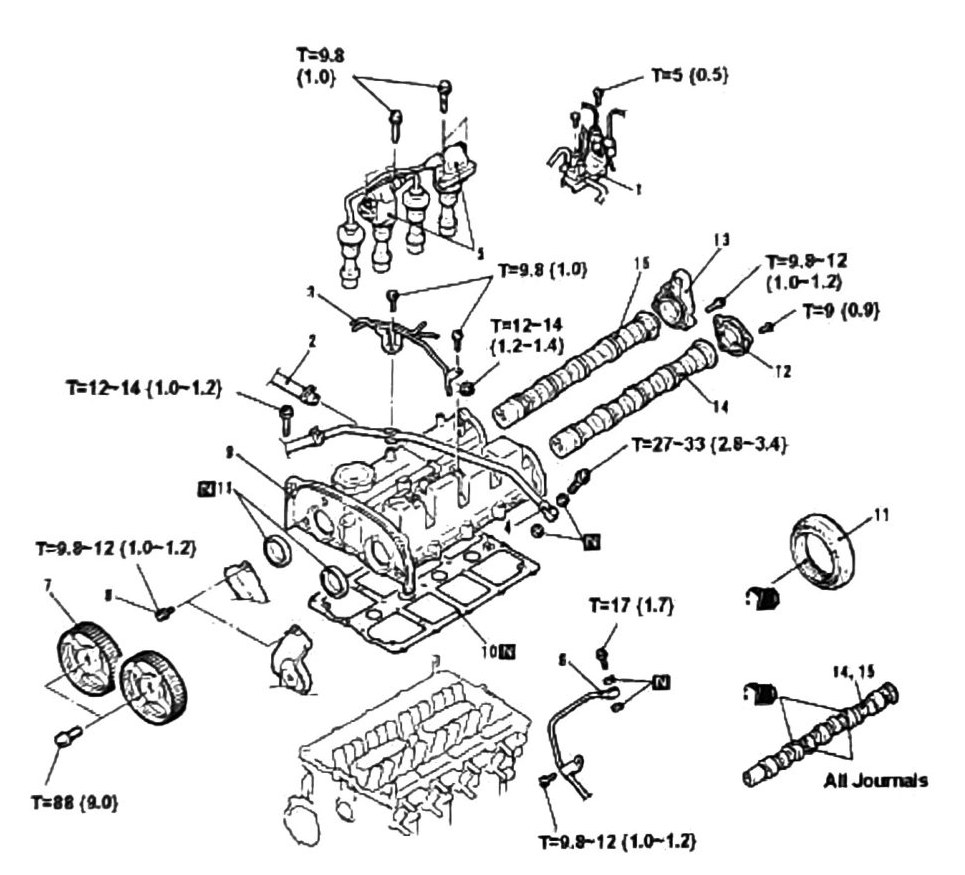
Removal order
- Connector bracket
- PCV hose — inspect, replace if cracked or split
- Remove vacuum pipe unit
- Disconnect water pipe
- Remove ignition coils and spark plug units
- Disconnect turbocharger oil pipe
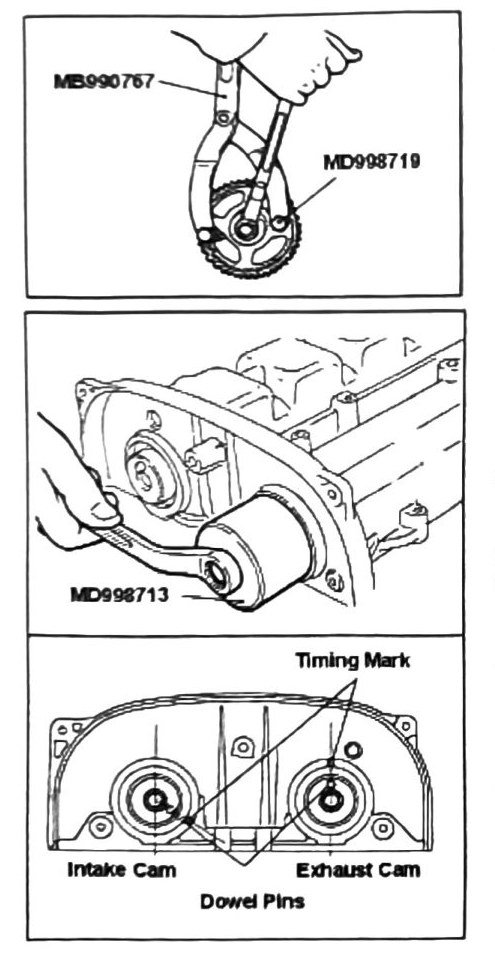
- Remove camshaft sprockets (retain with tools MB990767 and MD998719)
- Remove rear cover attachment bolts
- Remove camshaft housing assembly
- Remove camshaft housing gasket — always replace with a new unit
- Camshaft oil seal (see installation notes below)
- Camshaft retaining cover
- Crank sensor bracket retainer
- Remove exhaust camshaft
- Remove intake camshaft
- Install in reverse order
Note: coat all moving parts with SAE 30W engine oil before installation.
Camshaft retention
Use tools MB990767 and MD998719 to retain the camshaft sprocket in place during removal and installation.
Camshaft oil seal installation
Use tool MD998713 to install new oil seals. Coat new oil seals with SAE 30W engine oil before installation.
Camshaft and dowel pin alignment
Use the intake-cam/exhaust-cam/dowel-pin alignment diagram as a guide to proper camshaft and dowel pin alignment before final assembly.
Torque values
| Fastener | Torque |
|---|---|
| Camshaft housing bolts, all journals (see note) | 27–33 N·m (2.8–3.4 kgf·m; 20–24 ft-lb) |
Note: this DOHC “all journals” figure is very close to the SOHC camshaft journal torque in Section 18 (28–34 N·m / 2.9–3.5 kgf·m; 21–25 ft-lb), which supports the attribution, but it is not stated explicitly next to an “All Journals” label in this section the way it is in Section 18 — (verify printed p.44-45).
(verify printed p.44-45) — several additional torque callouts are visible in the source diagrams but could not be confidently matched to specific fasteners: T=9.8 N·m (1.0 kgf·m; 87 in-lb) (appears twice), T=5 N·m (0.5 kgf·m; 44 in-lb), T=9.8–12 N·m (1.0–1.2 kgf·m; 87–106 in-lb) (appears multiple times — possibly a common bolt size reused across several fasteners on this assembly), T=9 N·m (0.9 kgf·m; 80 in-lb), T=12–14 N·m (1.2–1.4 kgf·m; 106–124 in-lb), T=88 N·m (9.0 kgf·m; 65 ft-lb), and T=17 N·m (1.7 kgf·m; 150 in-lb). Confirm each against the printed page and diagram before use.