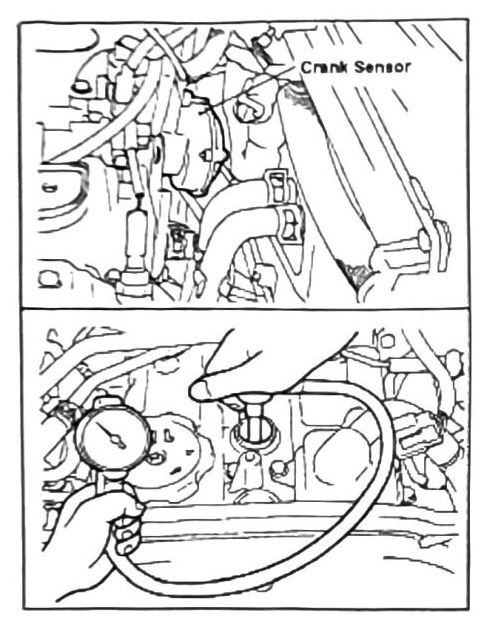
Engine Compression Test (SOHC & DOHC)
Note: Perform this test with the engine cold.
Preparation
- Remove intercooler (DOHC Turbo).
- Remove air intake tank (SOHC).
- Disconnect the crank sensor connector.
Note: Failure to disconnect the crank sensor circuit will cause the spark plugs to fire while the engine is cranked for the test.
Note: If the oil is dirty or thin, the test may not give an accurate result — only test compression with clean oil. If the oil was recently changed, run the engine a minimum of 5 minutes first, then shut off and allow the engine to cool to ambient temperature before testing.
Procedure
- Remove spark plugs one at a time.
- Attach a compression gauge as shown.
- Turn the engine over (default starter speed 400 RPM).
- Remove the gauge and reinstall the spark plug.
- Continue and complete testing on all 4 cylinders.
Compression specification
| Engine | Compression @ 400 RPM cranking |
|---|---|
| SOHC | 11.5 kg/cm² (164 psi) |
| DOHC Turbo | 9.0 kg/cm² (128 psi) |
(verify printed p.28) — the source labels these values “SOHC 2 Valve” and “SOHC-DOHC 5 Valve Turbo” rather than plainly SOHC/DOHC; see the labeling caveat in Section 8. The SOHC/DOHC split above follows the value ordering, which is consistent between this page and the printed p.22 summary table.
Results interpretation
If a spread of 1 kg/cm² (14 psi) is recorded between the 4 cylinders, further investigation may be required. On vehicles with over 100,000km (62,137mi), it is recommended to replace the piston rings. Always replace piston rings as a set — see the Engine Overhaul section of this manual for details.